Watch the First Five Minutes After Half-Time
Watch the first five minutes after half-time to spot changes in pressing and build-up, and distinguish a deliberate tactical shift from a brief restart wobble.
The first five minutes after half-time can expose a team’s adjustment to a specific opponent, especially in how it presses or builds from the back. Compare those moments with the same situations before the break: one rushed clearance is a clue, while a changed choice that recurs against the opponent’s response is more telling.
Keep the focus narrow. Note the opening pass from a goalkeeper restart, the player who initiates pressure, and what the opponent does next. This post-interval comparison is less about collecting general impressions than tracing a change-and-response sequence.
Choose comparable moments
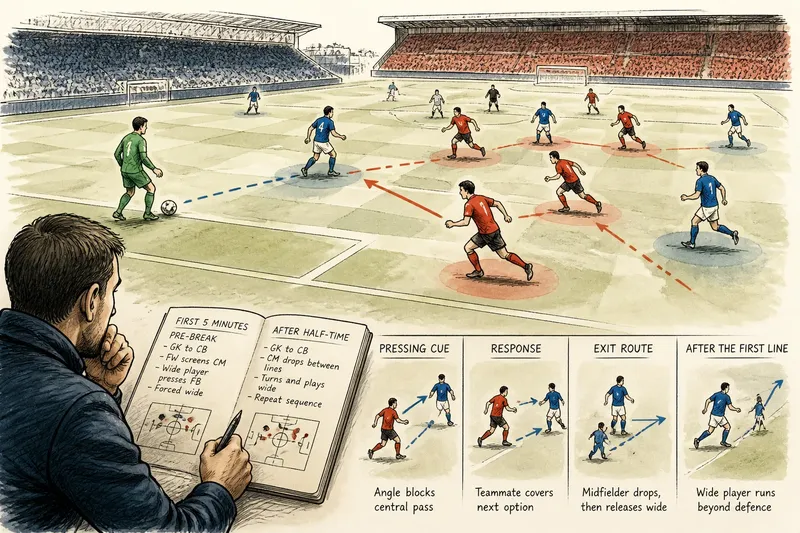
Before half-time, make a brief note when each team faces a goal-kick or a controlled restart from its goalkeeper. Record the first pass, the nearest presser and the route the pressing side appears to close. For example: “Forward screens central midfielder; wide player presses full-back.”
After the interval, compare like with like. A short pass from a centre-back under no pressure is not a fair match for a goalkeeper restart with an opponent charging forward. The score and substitutions matter too: they may explain why a team is taking more or less risk, without proving that its basic plan has changed.
Separate intent from response
An altered pass may reflect a new idea, or simply a new problem. If the opponent’s winger has moved higher, a defender may go long because the short route has become crowded; if the opponent retreats, the goalkeeper may have time to play short without any change in build-up design.
Look at what happened just before the choice. Did an opponent close the centre-back? Did a midfielder stop tracking a player dropping towards the defence? Did the pressing line shift towards one touchline? These details help distinguish a team’s initiative from its answer to pressure.
Then follow the next passage. A team might play over a high press, contest the second ball and return to short passes once the opponent backs off. That sequence can show adaptation rather than inconsistency: the useful observation is how the response changes with the pressure.
Read the pressing cue
A burst of pressure after the restart can look like a new plan, but it may follow a poor touch or an exposed pass. Check the next comparable build-up before treating it as a pattern.
When the opponent starts from the back, notice whether the first presser approaches at an angle that blocks a central pass. Watch whether a teammate covers the next option and whether the defenders move up behind them. Together, those movements can reveal a coordinated attempt to steer play towards a particular route.
Also note what the opponent does with the pass it is allowed. If the ball repeatedly goes wide and a midfielder then steps out to challenge, the press may be designed to funnel play towards the touchline. A single forced pass is weaker evidence: the defender’s preferred foot or a nearby teammate might have shaped it instead.
Compare the exit route
For the team building, record the first safe pass and what follows it. A centre-back pass to a full-back can still lead to the same long ball towards a striker; a midfielder dropping beside the defenders may instead offer a new way through the first line.
Imagine a side that usually sends its goalkeeper’s restart towards its striker. After the interval, the keeper passes to a centre-back, who finds a midfielder dropping into space; the midfielder turns and releases a wide player. Suppose the opponent is pressing with its front two each time. If that sequence recurs and the midfielder receives beyond their pressure, the reasonable reading is a possible revised escape route against that press—not proof that the whole formation has changed.
What happens after the first line is beaten matters as well. A forward coming short, a midfielder offering a nearby outlet or a wide player running beyond the defence can each help turn an escape pass into useful possession. The destination alone does not explain the route.
Judge the post-interval shift?
What counts as a changed pressing cue?
Compare who moves first and which passing lane that player blocks before and after the interval. If the same new cue appears against comparable restarts, it is more plausible that the pressing behaviour has shifted; if it follows only one loose touch, keep the reading tentative.
How can the opponent’s adjustment be spotted?
Watch the opponent’s starting positions and first movement on the same restart. If its forwards begin closer to the defenders or its midfield line jumps earlier, the other team’s altered pass may be a response to that pressure rather than a fresh build-up plan.
What if the broadcast follows the ball?
Use the direction of the forced pass as a provisional clue, then check the nearest visible presser and the next comparable passage. A tight camera angle can hide the player screening a central option, so avoid claiming more than the visible sequence supports.
Does a successful escape disprove the press?
No: a team can get through once while still being steered towards a difficult route repeatedly. Check the receiver’s body position, pressure and available next pass to see whether the escape creates a useful attack or merely moves the ball out of the first trap.
Keep a short record
A few concise notes can prevent the scoreline or one dramatic moment from taking over your reading. For each team, write down the pre-break cue, the post-break choice, the opponent’s response and whether the sequence appeared again.
- Check who initiates pressure on comparable goalkeeper restarts; if the same player repeatedly starts a coordinated press, note a possible shared cue, but if the first presser varies without cover, treat the sequence as unsettled.
- Check which passing lane is screened; if the centre is consistently closed, look for a deliberate funnel towards the flank, but if the route changes with each restart, avoid naming one fixed target.
- Check the opponent’s starting position; if its forwards move higher after the interval, consider that pressure as a cause of longer passes, but if the shape is unchanged, examine the building team’s own choices more closely.
- Check the first safe pass after a goalkeeper restart; if it changes and the next pass also uses a different route, note a possible build-up adjustment, but if the sequence quickly returns to its earlier pattern, mark it as a one-off.
- Check what follows a pass through the first line; if a nearby outlet or forward run supports the receiver, note an organised escape, but if the receiver is isolated, distinguish a completed pass from a useful solution.
- Check whether the same pattern returns in a later comparable possession; if it does, keep the adjustment as a plausible reading, but if it does not, leave the cause open and watch for another chance to compare.
The first five minutes after half-time are a useful window for comparing choices, not a verdict on the whole match. Treat your notes like labels on separate drawers: keep the pressing cue, build-up route and opponent response distinct until the sequence shows how they fit together. That makes the next adjustment easier to recognise without mistaking one noisy restart for a settled plan.