The Third-Player Run: Why the Best Pass Can Be the One Before It
The third-player run explains how a short pass can draw a marker away and free a teammate. Learn what to watch before the final pass arrives.
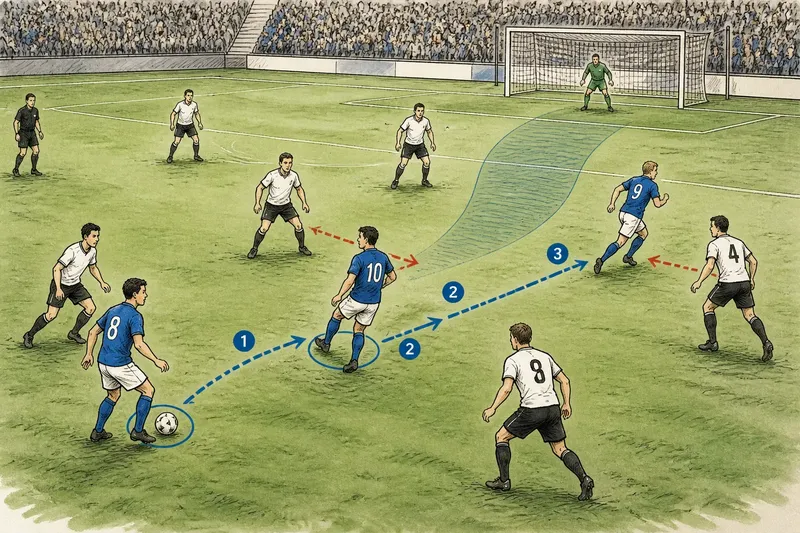
The third-player run turns a simple pass into a route through a defender’s blind spot. In football, the first pass often goes to a player who cannot turn; the important pass may be the next one, played to a teammate who has moved into the space that first exchange created. Watch the players around the ball, not just the ball itself, and the pattern becomes easier to read.
The passing triangle
Picture three teammates: a passer under pressure, a receiver with a defender tight behind, and a third player approaching from a different angle. The passer feeds the receiver, who lays the ball off or redirects it. The third player then runs onto that next pass, ideally facing forward and with the defender’s attention elsewhere.
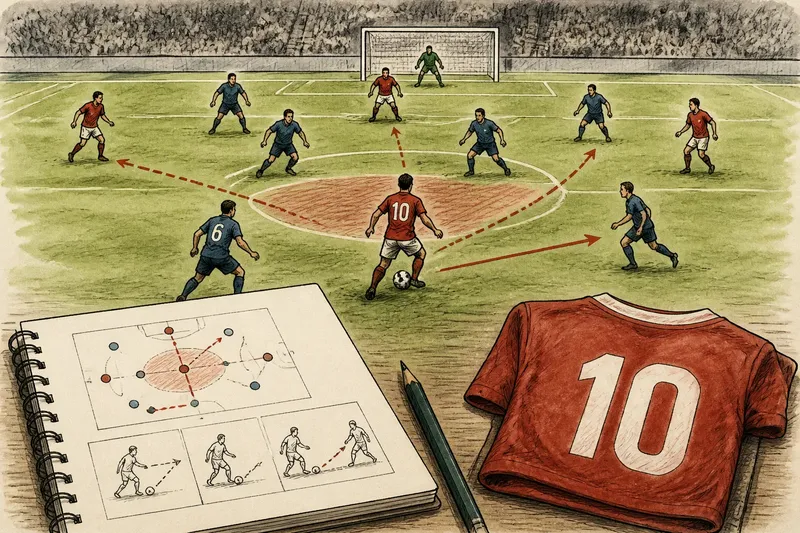
The receiver in the middle is often called the bounce player. Their job is not necessarily to beat an opponent or keep possession for long. A quick touch can change the angle of the attack and give the third player a way through a line that looked closed a moment earlier.
The move depends on timing and relationship, not a fixed formation. It can happen near the touchline, in central midfield or around the edge of the penalty area. Like passing a parcel across a crowded room, the useful route may be through someone who immediately hands it on, rather than straight to the person who wants it.
Two ways to release
Teams can use the bounce player in two broad ways. One is the quick lay-off: the receiver returns the ball with a short pass, and the third player arrives at speed. The other is the disguised release: the receiver holds the ball briefly, drawing a marker closer, then slips it into the runner’s path.
The quick lay-off suits a team that has a runner already moving and enough room for a one-touch exchange. It can be especially useful when a defender steps towards the receiver, leaving a channel behind. But if the runner sets off too early, the defence can track them; if the lay-off is loose, the move ends before it opens.
The disguised release suits a team whose receiver can shield the ball or turn a defender’s attention. That extra beat may let the third player change direction or arrive from a blind side. It asks the receiver to judge pressure carefully: hold on too long and the passing lane can shut.
A third option is a one-touch redirection rather than a conventional return pass. The bounce player might flick the ball sideways or into a diagonal lane, allowing the runner to approach from an unexpected angle. This can suit close combinations in crowded areas, though it calls for teammates to anticipate the same idea.
Clues before the pass
The best viewing clue is often the third player’s movement before the ball reaches the bounce player. Look for a small check away from a marker, a shoulder glance, or a change from a straight run to a curved one. These details can show that the runner is creating an angle rather than simply sprinting towards the goal.
Then watch the defender responsible for the central receiver. If that defender steps forward, turns their hips towards the ball, or gets close enough to challenge, they may be leaving the runner’s route less protected. A teammate might also pin another defender in place by staying wide or holding a high position.
Finally, notice the passer’s body shape. A player who can see both the receiver and the approaching runner has more options than one forced to face the touchline with a marker at their back. The pass to the bounce player may look safe or even dull, but the passer’s head and hips can hint at the next action.
Which route fits?
Choose the quick lay-off when the runner has a clear lane and the receiver can play the ball first time. Choose the disguised release when a defender is likely to rush the receiver and the runner needs a moment to slip away. A redirection is more attractive when the players are close together and the defence is focused on the obvious return pass.
Imagine a midfielder receiving with an opponent pressing from behind, while a forward starts a diagonal run between two defenders. The midfielder cushions the ball back to a supporting teammate, who immediately threads it into the forward’s path. If the defenders followed the midfielder’s touch, the forward should receive facing goal; if one defender held position, the same pass may be intercepted or force the forward wide.
That distinction helps separate a planned third-player pattern from a fortunate ricochet. Look for a runner who begins moving before the lay-off, a bounce player positioned to connect the passes, and a passer with an angle to find the next teammate. The play can still succeed through improvisation, but those cues reveal the structure beneath it.
Questions viewers ask?
What is a third-player run?
It is a movement by a teammate who receives the ball after it has first been played to another player. The middle player connects the pass and helps draw attention away from the runner’s route.
Is the bounce player always a midfielder?
No. A forward, full-back or centre-back can act as the bounce player, depending on where the combination happens. What matters is their position between the initial passer and the intended runner.
How is it different from a one-two?
In a simple one-two, the original passer often receives the return. In a third-player combination, a different teammate runs onto the next pass, so the ball travels through one player to reach another.
Why does the move sometimes fail?
The runner may move too soon, the bounce pass may lack accuracy, or a defender may stay goal-side and close the lane. Even a well-timed run needs the passer to recognise it and deliver before the space disappears.
Read the sequence
When watching a match, follow the likely runner for a moment before the ball arrives at the central player. Ask whether a defender is being drawn towards the ball, whether the runner is adjusting their line, and whether the passer can see the space ahead. Those small clues explain why the first pass may matter more than its modest appearance suggests.
The third-player run is not simply a clever pass routine; it is a way to make one defender choose between two threats. Once you spot the runner’s preparation and the bounce player’s role, the next pass becomes easier to anticipate. The most revealing moment may be the quiet movement just before the ball changes feet.