A High Line or a Deeper Block: Two Ways to Manage Space Behind
A high line or a deeper block changes where football’s dangerous space appears. Learn how each choice shapes pressure, cover, and the opponent’s next pass.
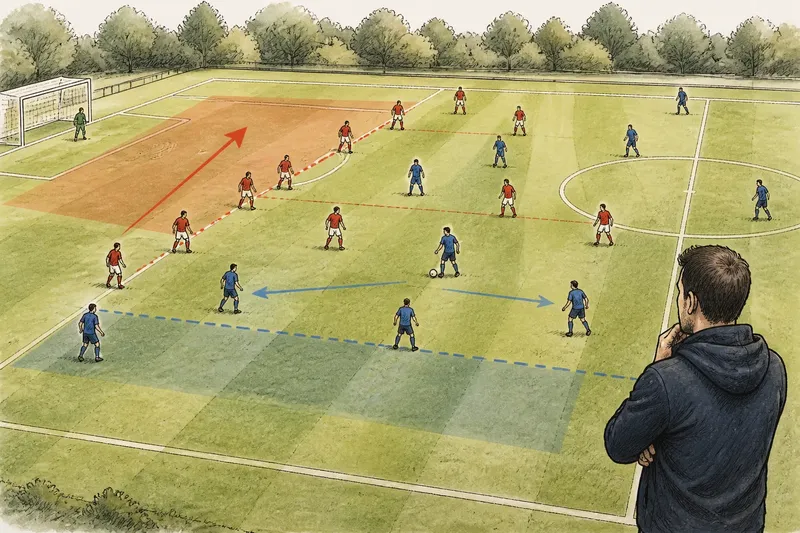
A high line or a deeper block is a decision about where to leave space, not whether to leave it. A team defending high squeezes the pitch towards the opponent’s goal; a team defending deep concedes ground nearer the halfway line to protect the area closer to its own goal. Each approach changes what the opponent can try, and what defenders must be ready to do next.
The choice is easiest to understand by watching the space behind the last defenders. In a high line, that space is large and potentially dangerous, but the opponent may have little time or room to deliver a useful pass into it. In a deeper block, the space behind the defence shrinks, while the areas in front and around the box become more crowded. The question is not simply which space is bigger. It is which space the defending team can control.
Where the line sits
A defensive line is the group of defenders closest to their own goal. Its position varies during a match, but the terms “high” and “deep” describe its general starting position when a team is organised without the ball.
A high line holds defenders nearer the halfway line, often alongside pressure from forwards and midfielders. The team tries to keep its units close together. That compact shape can make short passes difficult and leave an opponent with little time to turn. If defenders step forward together as the ball travels backwards, they can also make an opponent’s forwards more likely to be caught offside. The offside rule and the referee’s interpretation still govern each decision; the line itself does not make an attacker automatically offside.
A deeper block places the defensive line nearer its own penalty area, with midfielders usually retreating to close the space ahead of it. The opponent may be able to bring the ball farther upfield, but a pass beyond the defenders has less room to run into. The defenders can concentrate on protecting the goal-facing routes, while the midfielders try to obstruct passes through the middle and towards the edge of the box.
The high line’s bargain
Defending high can help a team recover the ball close to the opponent’s goal. If the first wave of pressure forces a poor touch, a hurried pass or a clearance, the rest of the team may already be close enough to contest the loose ball. The pressure can also discourage the opponent from building calmly from the goalkeeper.
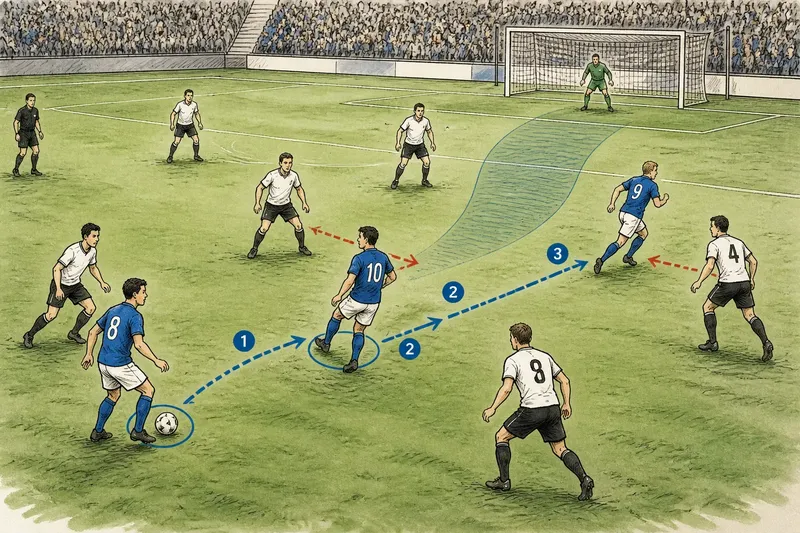
But a high line needs more than quick defenders. The pressure on the ball must arrive at the right time. If the player with the ball can look up and pass without being disturbed, an attacker can run into the space behind. A defender who steps forward alone may leave a teammate covering a different depth, opening a channel that a simple forward pass can exploit.
Goalkeeper position matters, too. A goalkeeper who starts high can help deal with passes played behind the line, particularly when defenders are pushed towards halfway. Yet that role depends on reading the pass and the runner, and on the goalkeeper’s comfort leaving the penalty area. If the ball is played over the line and the goalkeeper stays near the goal, the defenders may have to turn and race towards their own box with little cover.
The high line also has a hidden cost: it can invite direct play. An opponent may skip midfield with a long pass, aiming for a runner, a target forward or a second ball. The defending team then has to manage not only the first contest but also the loose ball around it. If its midfield is too far from the landing area, the initial clearance can simply give the opponent another attack.
The deeper block’s bargain
A deeper block reduces the room for opponents to run into behind the defence. It can be useful when the team wants to protect a lead, when its defenders are uncomfortable defending large open spaces, or when the opponent has fast forwards who threaten with early passes. By retreating, defenders can keep the goal and the space immediately in front of it as their main reference points.
That protection has a price. The opponent can often keep possession in front of the block and move the ball from side to side, looking for a gap between defenders or a crossing angle. A packed area may block direct passes towards goal, yet it can also make clearances difficult: defenders have few easy outlets, and the ball may return quickly.
There is also a risk of retreating too far. If the midfield line drops onto the defenders, the team may leave a large area in front of them for an opponent to receive and turn. That player can then carry the ball forward, draw a defender out or choose a pass without immediate pressure. A deep position protects the space behind, but it does not automatically protect the space between the lines.
To break out, the team needs an outlet. A forward can hold the ball long enough for teammates to advance, or a wide player can offer a route up the touchline. Without a reachable target, clearances tend to come straight back. The deeper block can then spend long spells defending, even when its first positioning has kept the opponent away from the most direct route to goal.
Reading the trade-offs
Think of the pitch like a row of chairs: move the defenders forward and the room behind them opens; move them back and more room appears in front. A team cannot remove that space simply by choosing a formation or calling a line high. It can only decide where to place the risk and organise its players to manage the consequences.
Several match conditions help explain why a coach might favour one position over another:
- Pressure on the passer: If forwards can close down the ball-holder and limit their view, a high line has more protection. If pressure is late or easily bypassed, defenders may have to defend a pass they cannot prevent.
- The threat of runs in behind: Fast, well-timed forward runs can punish a line that leaves a large gap behind it. A deeper block can reduce that runway, though it may give the opponent more time on the ball.
- Defenders’ movement and coordination: A high line asks defenders to step together, turn and recover. A deeper block asks them to hold their positions, track runners and defend crosses or combinations in crowded areas. Neither role is passive.
- Goalkeeper involvement: A high starting position can provide cover behind an advanced defence. In a deeper block, the goalkeeper is more likely to defend shots and deliveries closer to goal.
- The team’s route out: A high press may win the ball in an advanced area. A deep block may need a reliable forward or wide outlet to escape pressure after a regain.
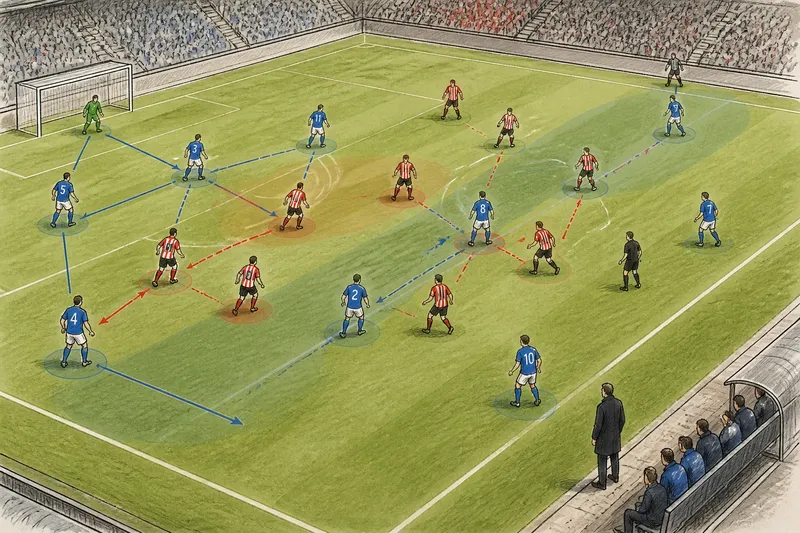
These factors interact. A team might begin with a high line, then drop when an opponent gets a clean touch facing forward. It might press aggressively near the touchline but retreat once the ball reaches the centre. What matters is whether players recognise the same cue and move as a unit, rather than treating the initial position as a permanent instruction.
What should you watch?
Why does a high line leave so much room behind?
When defenders move towards halfway, the distance between them and their own goal grows. That room becomes dangerous if the opponent can pass forward before pressure arrives, but it may stay unused if the ball-holder is hurried and the team keeps its shape.
Can a deep block still press the ball?
Yes. A team can defend close to its goal overall and still send a midfielder or forward to press a particular receiver. The rest of the block must cover the spaces that this movement leaves, or the opponent may pass around the pressure.
Which approach is safer against fast forwards?
A deeper line can reduce the space available for runs, but safety also depends on pressuring the passer and tracking movement. A high line may still be chosen if the team can close the ball quickly and cover behind; neither position removes the threat on its own.
How can you tell if a line is working?
Watch what the opponent can do after receiving the ball. A high line is functioning when the opponent struggles to play cleanly into the space behind, while a deep block is doing its job when the opponent cannot turn possession near the box into a clear route through or around the defence.
A match in miniature
Imagine a team whose centre-backs are quick, but whose forwards have stopped closing down the opposition’s centre-back. The defenders begin near halfway, yet the passer has time to lift their head and send a ball towards a runner. The coach asks the team to retreat a little and keep its midfield closer to the defenders until pressure improves. The observable change to look for is less open ground behind the line, alongside a greater need to challenge the opponent’s next pass in front of it.
That adjustment is not a verdict that high defending has failed. If the forwards begin arriving on time, the team may push up again. If the opponent keeps finding runners in behind, it may stay deeper or change who presses the passer. In either case, the line is a response to the relationship between pressure, cover and the available space.
When watching a match, track the ball-holder and the defenders together. A high line or a deeper block only makes sense in relation to how much time the opponent has to use the space. The most revealing moment is often the instant before the forward pass: see who is closing the ball, who is covering the runner, and whether the back line moves together. That small sequence shows where the defending team has chosen to accept risk.